 https://doi.org/10.63923/smhs.2026.127
Resumo
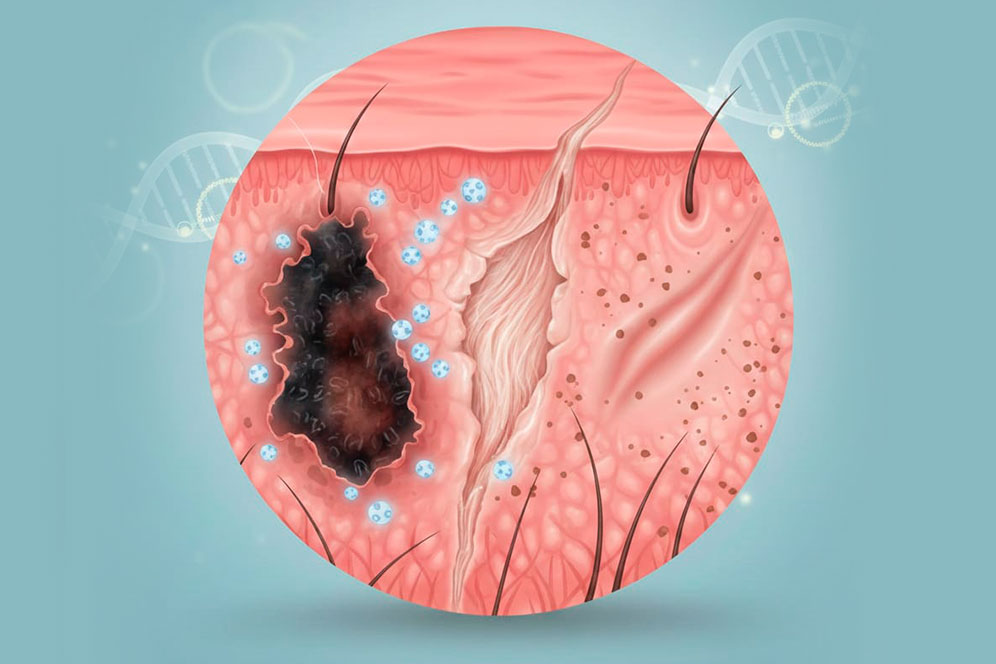
O melanoma cutâneo corresponde a uma neoplasia maligna derivada dos melanócitos, células especializadas na síntese de melanina. Entre os achados histopatológicos frequentemente observados, destaca-se a regressão tumoral, definida pela substituição parcial do tecido neoplásico por fibrose, infiltrado inflamatório linfocitário e alterações vasculares locais. Esse fenômeno é alvo de debate, visto que pode refletir tanto uma resposta imune antitumoral quanto um fator associado a maior risco de metástase. O presente estudo teve como objetivo realizar uma revisão integrativa da literatura com a finalidade de analisar a influência da regressão histológica sobre desfechos clínicos relevantes no melanoma cutâneo, tais como metástase linfonodal, sobrevida global e sobrevida livre de doença. A metodologia foi conduzida por meio de uma revisão integrativa da literatura por meio de buscas sistemáticas nas bases PubMed, Cochrane e Embase. Foram incluídos estudos observacionais e ensaios clínicos que abordassem a relação entre regressão tumoral e prognóstico no melanoma cutâneo, sem restrições quanto ao período de publicação ou tempo de seguimento. Os achados mostraram que a regressão histológica ocorre em 20–25% dos melanomas, principalmente em lesões finas, refletindo resposta imunológica com fibrose dérmica e infiltrado linfocitário. Embora associada a menor comprometimento nodal e risco de recidiva em alguns casos, não exclui metástases, devendo ser considerada apenas como marcador prognóstico complementar. A regressão tumoral no melanoma cutâneo permanece um achado de importância clínica e histopatológica, entretanto, seu valor prognóstico ainda é controverso. Enquanto alguns estudos sugerem associação com melhor resposta imune e potencial redução no risco de progressão, outros relacionam a regressão à subestimação da espessura tumoral e, consequentemente, a maior risco de metástase. Assim, novos estudos prospectivos, com maior padronização metodológica, são necessários para elucidar de forma definitiva o impacto da regressão na evolução clínica do melanoma.
Referências
- AIVAZIAN, K., AHMED, T., EL SHAROUNI, M., STRETCH, J. R., SAW, R. P. M., SPILLANE, A. J., SHANNON, K. F., CH´NG, S., NIEWEG, O. E., THOMPSON, J. F., LO, S. N., SCOLYER, R. A. Histological regression in melanoma: impact on sentinel lymph node status and survival. Mod. Pathol. 2022. Disponível em: <https://www.embase.com/search/results?subaction=viewrecord&id=L2013114515&from=export%20U2%20-%20L2013114515>. Acesso em: 27 set. 2025.
- AUNG, P. P., NAGARAJAN, P., PRIETO, V. G. Regression in primary cutaneous melanoma: Etiopathogenesis and clinical significance. Lab. Investig., Volume 97, capítulo 6, pág. 657-668, 2017. Disponível em: <https://www.embase.com/search/results?subaction=viewrecord&id=L616516487&from=export%20U2%20-%20L616516487>. Acesso em: 27 set. 2025.
- AZULAY, Rubem David; AZULAY, David Rubem; AZULAY-ABULAFIA, Luna. Dermatologia. 7. ed. Rio de Janeiro: Guanabara Koogan, 2017.
- BOTELLA-ESTRADA, R., TRAVES, V., REQUENA, C., GUILLEN-BARONA, C., NAGORE, E. Correlation of histologic regression in primary melanoma with sentinel node status. JAMA Dermatol, Volume 150, capítulo 8, pág. 828-835, 2014. Disponível em: <https://www.embase.com/search/results?subaction=viewrecord&id=L373844587&from=export%20U2%20-%20L373844587>. Acesso em: 27 set. 2025.
- CARCELAIN, G., ROUAS-FREISS, N., ZORN, E., CHUNG-SCOTT, V., VIEL, S., FAURE, F., BOSQ, J., HERCEND, T. In situ T-cell responses in a primary regressive melanoma and subsequent metastases: a comparative analysis. International journal of cancer, Volume 72, capítulo 2, pág. 241-7, 1997. Disponível em: <https://pubmed.ncbi.nlm.nih.gov/9219827/>. Acesso em: 27 set. 2025.
- CINTOLO, J. A., GIMOTTY, P., BLAIR, A., GUERRY, D., ELDER, D. E., HAMMOND, R., ELENITSAS, R., XU, X., FRAKER, D., SCHUCHTER, L. M., CZERNIECKI, B. J., KARAKOUSIS, G. Local immune response predicts survival in patients with thick (T4) melanomas. Ann. Surg. Oncol., Volume 20, capítulo 11, pág. 3610-3617, 2013. Disponível em: <https://www.embase.com/search/results?subaction=viewrecord&id=L52672180&from=export%20U2%20-%20L52672180>. Acesso em: 27 set. 2025.
- CZARNETZKI, B. M., DENTER, M., BROCKER, E. B., RUMKE, P., KRIEG, V., VAKILZADEH, F., MACHER, E. Clinical features of superficial spreading melanomas with zones of regression. Journal of cancer research and clinical oncology, Volume 107, capítulo 3, pág. 225-8, 1984. Disponível em: <https://pubmed.ncbi.nlm.nih.gov/6735111/>. Acesso em: 27 set. 2025.
- EL SHAROUNI, M., AIVAZIAN, K., WITKAMP, A. J., SIGURDSSON, V., GILS, C. H., SCOLYER, R., THOMPSON, J. F., DIEST, P. J. LO, S. N., A. Association of Histologic Regression with a Favorable Outcome in Patients with Stage I and Stage 2 Cutaneous Melanoma. JAMA Dermatol, Volume 157, capítulo 2, pág. 166-173, 2021. Disponível em: <https://pubmed.ncbi.nlm.nih.gov/33367893>. Acesso em: 27 set. 2025.
- GERSHENWALD, J. E., Scolyer, R. A., Hess, K. R., et al. (2017). The American Joint Committee on Cancer (AJCC) eighth edition melanoma staging system: implications for melanoma treatment and care. CA: A Cancer Journal for Clinicians, 67(6), 472-492.
- KANG, S., BARNHILL, R. L., MIHM Jr., M. C., SOHER, A. J. Histologic regression in malignant melanoma: an interobserver concordance study. Journal of cutaneous pathology, Volume 20, capítulo 2, pág. 126-9, 1993. Disponível em: <https://pubmed.ncbi.nlm.nih.gov/8320356/>. Acesso em: 27 set. 2025.
- KAUR, C., THOMAS, R. J., DESAI. N., GREEN, M. A., LOVELL, D., POWELL, B. M., COOK, M. G. The correlation of regression in primary melanoma with sentinel lymph node status. Diagnostic clinical pathology, Volume 61, capítulo 3, pág. 297-300, 2007. Disponível em: <https://pubmed.ncbi.nlm.nih.gov/17675538/>. Acesso em: 27 set. 2025.
- KELLY, J. W., SAGEBIEL, R. W., BLOIS, M. S. Regression in malignant melanoma. A histologic feature without independent prognostic significance. Cancer, Volume 56, capítulo 9, pág. 2287-91, 1985. Disponível em: <https://pubmed.ncbi.nlm.nih.gov/4052972/>. Acesso em: 27 set. 2025.
- LETCA, A. F., UNGUREANU, L., SENILA, S. C., GRIGORE, L. E., POP, S., FECHETE, O., VESA, S. C., COSGAREA, R. Regression and Sentinel Lymph Node Status in Melanoma Progression. Medical science monitor : international journal of experimental and clinical research, Volume 24, pág. 1359-1365. 2018. Disponível em: <https://pubmed.ncbi.nlm.nih.gov/29507279/>. Acesso em: 27 set. 2025.
- MCCLAIN, S. E., SHADA, A. L., BARRY, M., PATTERSON, J. W., SINGLUFF Jr., C. L. Outcome of sentinel lymph node biopsy and prognostic implications of regression in thin malignant melanoma. Melanoma research, Volume 22, capítulo 4, pág. 302-9, 2012. Disponível em: <https://pubmed.ncbi.nlm.nih.gov/22610274/>. Acesso em: 27 set. 2025.
- MISHARA, A., BARBIERI, A., NOTTINGHAM, J. F., MOZZI P., WOO, P. N. Completely regressed primary cutaneous melanoma presenting with nodal metastasis: A case with sequential photographic evidence. J. Am. Acad. Dermatol., Volume 68, capítulo 4, pág. 151, 2013. Disponível em: <https://www.embase.com/search/results?subaction=viewrecord&id=L70997685&from=export%20U2%20-%20L70997685>. Acesso em: 27 set. 2025.
- OSELLA-ABATE, S., CONTI, L., ANNARATONE, L., SENETTA, R., BERTERO, L., LICCIARDELLO, M., CALIENDO, V., PICCIOTTO, F., QUAGLINO, P., CASSONI, P., RIBERO, S. Phenotypic characterisation of immune cells associated with histological regression in cutaneous melanoma. Pathology, Volume 51, capítulo 5, pág. 487-493, 2019. Disponível em: <https://www.embase.com/search/results?subaction=viewrecord&id=L2002192301&from=export%20U2%20-%20L2002192301>. Acesso em: 27 set. 2025.
- RIBERO, S., QUAGLINO, P., OSELLA-ABATE, S., SANLORENZO, M., SENETTA, R., MACRI, L., SAVOIA, P., MACRIPO, G., SAPINO, A., BERNENGO, M. G. Relevancy of multiple basin drainage and primary histologic regression in prognosis of trunk melanoma patients with negative sentinel lymph nodes. J. Eur. Acad. Dermatol. Venereol., Volume 27, capítulo 9, pág. 1132-1137, 2013. Disponível em: <https://www.embase.com/search/results?subaction=viewrecord&id=L52228202&from=export%20U2%20-%20L52228202>. Acesso em: 27 set. 2025.
- RIBERO, S., GALLI, F., OSELLA-ABATE, S., BERTERO, L., CATTANEO, L., MERELLI, B., TONDINI, C., GHILARDI, L., GIORGI, V., OCELLI, M., QUAGLINO, P., CASSONI, P., PALMIERI, G., MASSI, D., MANDALA, M. Prognostic impact of regression in patients with primary cutaneous melanoma >1 mm in thickness. J. Eur. Acad. Dermatol. Venereol., Volume 80, capítulo 1, pág. 99-105.e5, 2019. Disponível em: <https://www.embase.com/search/results?subaction=viewrecord&id=L2001281158&from=export%20U2%20-%20L2001281158>. Acesso em: 27 set. 2025.
- SAMPAIO, Sebastião A. P.; RIVITTI, Evandro A. Manual de dermatologia clínica de Sampaio e Rivitti. 1. ed. São Paulo: Artes Médicas, 2014.
- SUBRAMANIAN, S., HAN, G., OLSON, N., LEONG, S. P., KASHANI-SABET, M., WHITE, R. L., ZAGER, J. S., SONDAK, V. K., MESSINA, J. L., POCKAJ, B., KOSIOREK, H. E., VETTO, J., FOWLER, G., SCHNEEBAUM, S., HAN, D. Regression is significantly associated with outcomes for patients with melanoma. Surgery, Volume 170, capítulo 5, pág. 1487-1494, 2020. Disponível em: <https://pubmed.ncbi.nlm.nih.gov/34120749/>. Acesso em: 27 set. 2025.
- TESTES, A., SALVO, G. L., MONTESCO, M. C., TRIFIRO, G., MOCELLIN, S., LANDI, G., MACRIPO, G., CARCOFORO, P., RICOTTI, G., GIUDICE, G., PICCIOTTO, F., DONNER, D., FILIPPO, F., SOTELDO, J., CASARA, D., SCHIAVON, M., VECCHIATO, A., PASQUALI, S., BALDINI, F., MAZZAROL, G., ROSSI, C. R. Clinical considerations on sentinel node biopsy in melanoma from an Italian multicentric study on 1,313 patients (2000-2006). Ann. Surg. Oncol., Volume 16, capítulo 7, pág. 2018-2027, 2008. Disponível em: <https://www.embase.com/search/results?subaction=viewrecord&id=L50387273&from=export%20U2%20-%20L50387273>. Acesso em: 27 set. 2025.
- THORN, M., PONTÉN, F., BERGSTROM, R., SPARÉN, P., ADAMI, H. Trends in tumour characteristics and survival of malignant melanoma 1960-84: a population-based study in Sweden. British journal of cancer, Volume 70, capítulo 4, pág. 743-8, 1994. Disponível em: <https://pubmed.ncbi.nlm.nih.gov/7917932/>. Acesso em: 27 set. 2025.
- TRAU, H., KOPF, A. W., RIGEL, D. S., LEVINE J., ROGERS, G., LEVENSTEIN, M., BART, R. S., MINTZIS, M. M., FRIEDMAN, R. J. Regression in malignant melanoma. Journal of the American Academy of Dermatology. Volume 8, capítulo 3, pág. 363-8. 1983. Disponível em: <https://pubmed.ncbi.nlm.nih.gov/6833536/>. Acesso em: 27 set. 2025.
- WOLFF, K. Dermatologia de Fitzpatrick: atlas e texto. 8. ed. Porto Alegre: AMGH, 2019.
- YANG, J., JONES, M. S., RAMOS, R. I., CHAN, A. A., LEE, A. F., FOSHAG, L. J., SIELING, P. A., FARIES, M. B., LEE, D. J. Insights into local tumor microenvironment immune factors associated with regression of cutaneous melanoma metastases by Mycobacterium bovis Bacillus Calmette-Guerin. Cancer Immunol. Immunother., Volume 7, capítulo 0, 2007. Disponível em: <https://www.embase.com/search/results?subaction=viewrecord&id=L615928016&from=export%20U2%20-%20L615928016>. Acesso em: 27 set. 2025.
- ZUGNA, D., SENETTA, R., OSELLA-ABATE, S., FIERRO, M. T., PISACANE, A., ZACCAGNA, A., SAPINO, A., BATAILLE, V., MAURICHI, A., PICCIOTTO, F., CASSONI, P., QUAGLINO, P., RIBERO, S. Favourable prognostic role of histological regression in stage III positive sentinel lymph node melanoma patients. EJCCancer, Volume 118, capítulo 3, pág. 396-404, 2018. Disponível em: <https://www.embase.com/search/results?subaction=viewrecord&id=L6205016448&from=export%20U2%20-%20L6205016448>. Acesso em: 27 set. 2025.